Chardham Yatra
-
Haridwar
-
Mini Bus
-
Card/UPI
-
3 * Hotel
-
Summer & Spring
-
Breakfast and Dinner
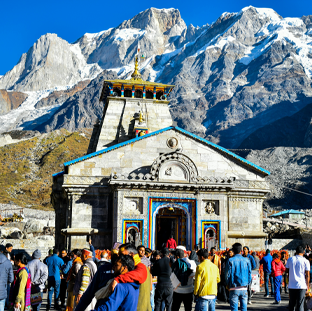
Kedarnath is one of the holiest Hindu pilgrimage sites, dedicated to Lord Shiva, located in the Rudraprayag district of Uttarakhand. It’s the highest among the 12 Jyotirlingas and a key part of the Char Dham Yatra (along with Badrinath, Gangotri, and Yamunotri).
Overview
🌄 1. Introduction
The Kedarnath–Badrinath Yatra is a revered Do Dham pilgrimage in the Himalayas of Uttarakhand, India.
It takes devotees through two of the most powerful temples — Kedarnath (Lord Shiva) and Badrinath (Lord Vishnu) — representing the union of Shiva and Vishnu, the two supreme forms of the Divine.
Undertaking this Yatra is believed to wash away sins, balance karma, and help attain moksha (liberation).
🔱 2. Spiritual Significance
| Dham | Deity | Symbolizes | Energy Element |
|---|---|---|---|
| Kedarnath | Lord Shiva (Jyotirlinga) | Strength, renunciation, and devotion | Earth (Stability) |
| Badrinath | Lord Vishnu (Badri Narayan) | Compassion, preservation, and liberation | Water (Flow & Grace) |
Together, they symbolize the journey from penance to peace, from the destruction of ego (Kedarnath) to the realization of divine truth (Badrinath).
📜 3. Mythological Background
🕉️ Kedarnath
One of the 12 Jyotirlingas of Lord Shiva.
Myth: After the Mahabharata, the Pandavas sought forgiveness from Lord Shiva.
Shiva avoided them by taking the form of a bull.
When Bhima tried to grab him, he dived into the ground — his hump appeared in Kedarnath.
Other parts appeared in different places known as the Panch Kedar temples.
The present temple was rebuilt by Adi Shankaracharya in the 8th century CE.
🌺 Badrinath
Dedicated to Lord Vishnu in his meditative form (Badri Narayan).
Myth: Lord Vishnu meditated here, and Goddess Lakshmi took the form of a Badri tree to protect him from the cold.
The temple was established by Adi Shankaracharya, who found the Saligram idol of Vishnu in the Alaknanda River.
🗺️ 4. Geography & Location
| Temple | District | Altitude | River | Coordinates |
|---|---|---|---|---|
| Kedarnath | Rudraprayag | 3,583 m | Mandakini | 30.73°N, 79.07°E |
| Badrinath | Chamoli | 3,133 m | Alaknanda | 30.74°N, 79.49°E |
The route passes through dense forests, valleys, snow-clad peaks, and river confluences (Prayags) — each carrying deep symbolic meaning.
🚙 5. Travel Route (from Haridwar/Rishikesh)
Route Flow:Haridwar / Rishikesh → Guptkashi → Kedarnath → Joshimath → Badrinath → Rishikesh / Haridwar
Total Distance: ~900–1,000 km
Ideal Duration: 6–7 days (by road)
Helicopter Option: 1–2 days
🏔️ 7. About the Two Temples
🔹 Kedarnath Temple
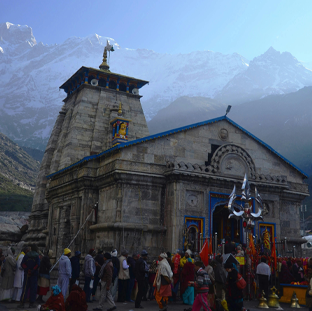
Built from grey stone slabs with no cement — architecture withstands extreme cold.
Behind the temple stands Kedarnath Peak (6,940 m) — symbolic of Lord Shiva’s eternal presence.
Inside: a conical-shaped black stone (Shiva Linga) representing the bull’s hump.
Panch Kedar Connection: Tungnath, Rudranath, Madhyamaheshwar, Kalpeshwar.
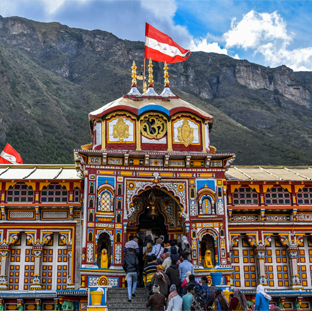
🔹 Badrinath Temple
Situated between Nar and Narayan mountain ranges.
Idol: 1-meter tall black stone idol (Shaligram) of Lord Vishnu seated in Padmasana (lotus posture).
Other nearby shrines:
Tapt Kund (hot spring)
Mana Village (last Indian village)
Vyas & Ganesh Gufa (caves)
Saraswati River Origin
🚁 8. Helicopter Yatra (Premium Option)
Route: Dehradun → Kedarnath → Badrinath → Dehradun
Duration: 1 day (6–8 hours total)
Operators: Heritage Aviation, Pawan Hans, Aryan Aviation, IRCTC
Includes: VIP darshan, shuttle transfers, meals.
Typical Schedule:
06:00 AM – Depart from Dehradun
07:00 AM – Kedarnath Darshan
11:00 AM – Badrinath Darshan
03:00 PM – Return to Dehradun
📅 9. Opening & Closing Timings
| Temple | Opening (Approx.) | Closing (Approx.) |
|---|---|---|
| Kedarnath | Akshaya Tritiya (April/May) | Bhai Dooj (Oct/Nov) |
| Badrinath | Akshaya Tritiya | Vijayadashami or Diwali |
Kedarnath idol shifted to Omkareshwar Temple, Ukhimath.
Badrinath idol shifted to Narsimha Temple, Joshimath.
💫 10. Spiritual Essence
Temple
Symbolic Transformation
Kedarnath
Ego dissolves in the presence of Shiva — the soul learns detachment.
Badrinath
Devotion blossoms; the soul attains divine peace and grace.
Together, the journey reflects self-purification and divine realization — moving from sacrifice (Shiva) to salvation (Vishnu).
🛕 11. Summary Table
| Aspect | Details |
|---|---|
| Route | Haridwar → Kedarnath → Badrinath → Haridwar |
| Total Duration | 5–6 Days |
| Best Time | May–June & Sept–Oct |
| Altitude Range | 3,000–3,600 m |
| Main Deities | Lord Shiva (Kedarnath) & Lord Vishnu (Badrinath) |
| Mode of Travel | Road + Trek / Helicopter |
| Significance | Union of Shiva & Vishnu – path to moksha |
🌟 13. Symbolic Interpretation
Spiritually, the Kedarnath–Badrinath Yatra is seen as a journey within:
At Kedarnath, one renounces worldly attachments (Shiva’s path).
At Badrinath, one experiences divine compassion (Vishnu’s grace).
Together, they complete the cycle of detachment and devotion, leading to liberation.
Highlights
- Trek to the world-famous Everest Base Camp
- Enjoy the amazing view of the Himalayas from Kala Patthar